Edinburgh’s Elephant in the Room
In the years since 1950, the emblematic silhouette of the city has sported the skeletal ribcage of the Tattoo stadium scaffolding in various states of deconstruction for an accumulated time of more than thirty years. Between the years of 1975 and 2010, the entire cycle of assembly and deconstruction took approximately twenty-five weeks, meaning that for nearly half the year, through the high tourist seasons, the castle of the postcards was somehow obscured.
The present stadium, although quicker to assemble and dismantle, lingers on the Esplanade for a similar period, broadly from May until early October. It is no great stretch to imagine that this ritual would still be observed even if it took eleven months; for the castle is presented in the city’s narrative as both simultaneously a pristine historical monument, and ablaze with fireworks and the pomp of the Tattoo, and as such, the scaffold is obscured under the coloured lights and thousands of spectators. The stadium is, to mix metaphors, Schrödinger’s elephant in the room.
The curious situation of the conspicuously inconspicuous stadium possibly finds its root in the second dichotomy of the castle - the transition from an object used to repel outsiders into the city’s greatest attraction. The battlements have for the most part been used to repel, by firing cannon at those wishing to get inside; today the castle attracts millions of visitors annually, who shoot salvos of photographs from the castle walls. The development of the city from its isolationist origins to its globalised present is explored by the theorist Boris Groys’ writing in The City in the Age of Touristic Reproduction.
The city walls once delineated the place where a city was built, clearly designating its utopian character… a genuine city is not only utopian, it is also anti-tourist: it dissociates itself from space and moves through time.
In modern times, however, this utopian impulse, the quest for an ideal city, has grown progressively weaker and gradually been supplanted by the fascination of tourism. Today, when we cease to be satisfied with the life that is offered to us in our own cities, we no longer strive to change, revolutionize or rebuild this city; instead, we simply move to a new city - for a short period or forever - in search of what we miss in our home city.
Groys describes a world where utopia is not a progressive goal of a city, but perpetually elsewhere, made up of fragments of different cities, pieced together in the patchwork of the tourist’s Instagram account: A Venetian canal, a continental Plaza, and Edinburgh’s castle.
Despite the appreciation of history, a romantic tourist’s mentality is conservative and ultimately ahistorical in its attitude to the built environment. It is this conservative gaze of the transient tourist that has been adopted by conservationists and councils in historic centres today.
The touristic gaze romanticizes, monumentalizes and eternalizes everything that comes within its range. In turn, the city adapts to this materialized utopia, to the medusan gaze of the romantic tourist… A city's monuments, after all, have not always been standing there simply waiting for tourists to see them.
Qualities of the medusan gaze described by Groys is found in the medievalising additions to the castle during the 19th century, fixing the castle temporally, as we continue to indulge romantic fantasy for the benefit of the tourist, the process of monumentalising is accelerated. Today’s additions are found in the form of the temporary skeletal structure that tiptoes around the Scots Baronial confection of the gatehouse, the brutally utilitarian defensive walls, and even the tarmac of the esplanade, further pushing the castle into the past.
To anyone who collectively had a hand in the castle's construction over the past millennia, the notion of the castle as a complete and ideal monument would be alien, for the form that defines Edinburgh’s skyline is that of an accretion of buildings built as necessity demanded. Each addition serves to adapt the rocky outcrop to its changing role in the heart of the city. Its continual repurposing as Fortification, Royal Residence, Barracks, Prison and Victorian romantic symbol are all embroidered into the castle's fabric; and are indeed its sum total.
So how do we continue the story of the city? To visit the castle is to visit a cross section of Edinburgh’s social and political history manifest in stone. One of the castle’s most celebrated roles today is as the venue of Tattoo, where this collection of built history is celebrated as the backdrop to the festivities. Yet the tattoo itself, despite its enduring presence is not inscribed in this history.
The construction a permanent open-air amphitheatre could provide Edinburgh with the permanent venue that places the current, lived history into the colourful fabric of the castle in a manner that adds both in terms of utility and aesthetics. The situation offers us a chance to recover our ability to positively form the cities in which we dwell, by positively directing the Romantic medusan gaze as a tool for construction rather than stagnation, turning the scaffold into stone.
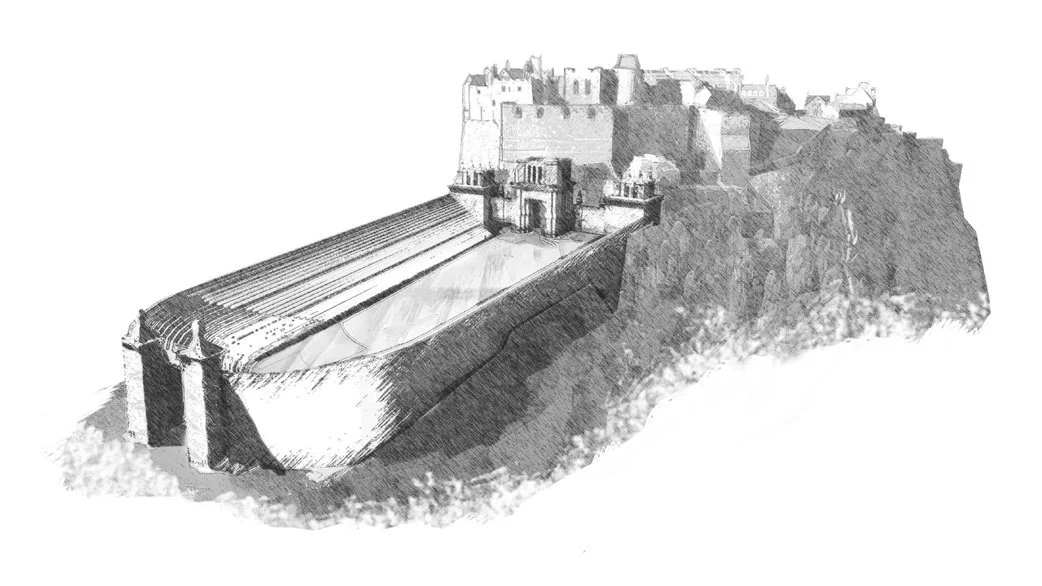
Conceptual sketch of a permanent esplanade stadium
Originally published in Crumble Magazine, Issue 2: What’s the Plan?, Winter 2018. This revised version has been lightly edited and updated for publication on Edinburgh Steps, including updated information on the history and duration of the Tattoo stadium’s occupation of the Castle Esplanade.